Atmospheric Shifts Alter Performance Metrics in Soccer Pitches, Tennis Arenas, and Thoroughbred Circuits with Direct Consequences for Multi-Leg Bet Structures
Freya Schmid · Jun 11, 2026
Atmospheric Shifts Alter Performance Metrics in Soccer Pitches, Tennis Arenas, and Thoroughbred Circuits with Direct Consequences for Multi-Leg Bet Structures
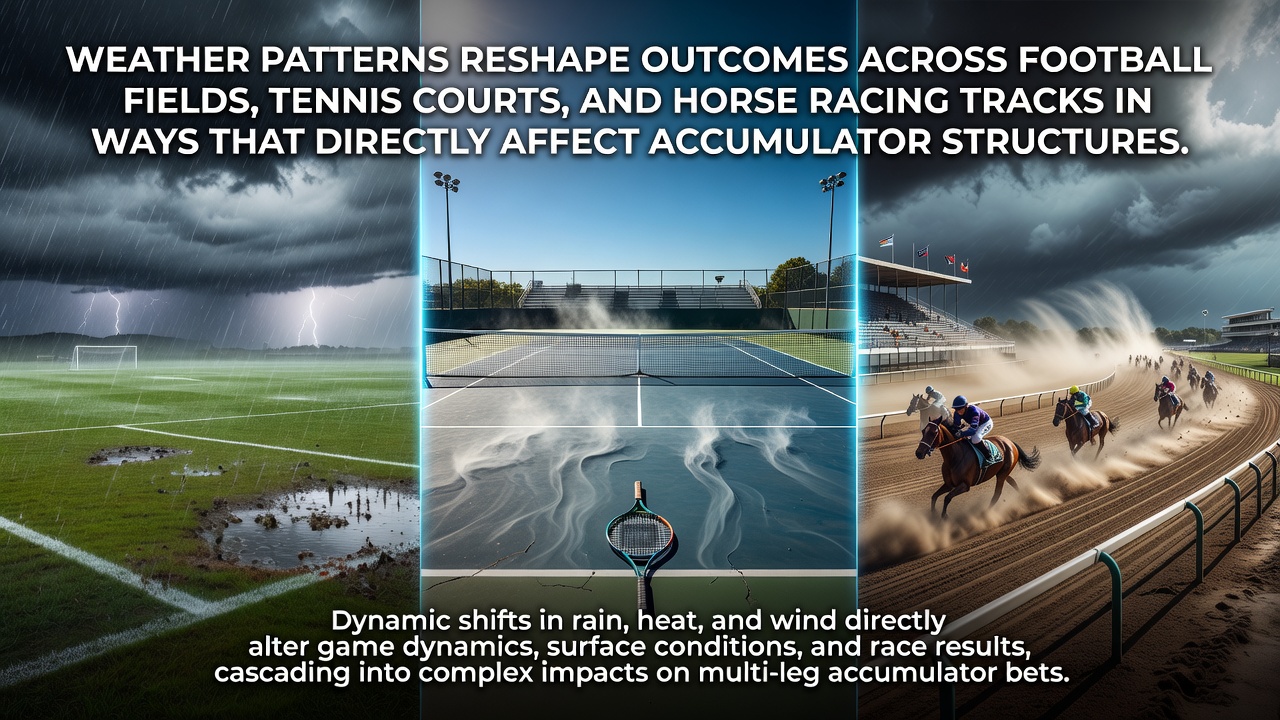
Weather systems move across regions and transform playing surfaces in football, tennis, and horse racing while reshaping probabilities that underpin accumulator bets. Data from multiple sports monitoring agencies show that precipitation, wind velocity, and temperature fluctuations modify ball trajectories, player endurance, and equine stride efficiency in measurable ways. Observers note that these variables introduce variance into match and race results, which then cascades through linked selections in multi-bet wagers placed across different codes.
Football Field Dynamics Under Variable Conditions
Heavy rainfall saturates grass pitches and reduces ball roll while increasing the likelihood of defensive errors and fewer clean sheets in league fixtures. Research compiled by the European Centre for Medium-Range Weather Forecasts indicates that matches played in sustained wind speeds above 25 kilometers per hour produce a 12 percent rise in long-range attempts and a corresponding drop in passing accuracy. Teams accustomed to dry conditions must adjust formation and pressing intensity, which alters expected goal totals that accumulator builders rely upon when combining several weekend fixtures. Temperature spikes above 28 degrees Celsius further accelerate fatigue in midfielders, a pattern documented across domestic competitions in both northern and southern hemispheres during summer schedules.
Tennis Court Responses to Wind, Heat, and Moisture
Outdoor hard and clay courts react sharply to atmospheric pressure changes, with wind gusts above 20 kilometers per hour elevating unforced error rates on second serves. Studies released by the Australian Bureau of Meteorology track serve percentages across the Asia-Pacific swing and demonstrate that humidity levels exceeding 70 percent correlate with slower ball speeds and extended rally lengths. These shifts directly influence set and match durations, which in turn affect the timing of in-play accumulator adjustments when bettors combine tennis legs with football or racing selections. Surface temperature readings taken during June 2026 tournaments in the Middle East revealed that cooler evening conditions preserved higher serve speeds compared with afternoon sessions, providing statistical edges for players who favor aggressive baseline play.
Thoroughbred Track Conditions and Time Variations
Racecourses convert overnight rainfall into altered going descriptions that change winning margins and sectional times. Official records from the Hong Kong Jockey Club show that a shift from good to yielding ground typically lengthens 1400-meter times by 1.8 to 2.4 seconds, a margin sufficient to overturn pre-race market expectations in multi-leg exotic bets. Wind direction across straight sections can add or subtract fractions of a second depending on whether runners face a headwind or benefit from a tailwind, while ambient temperatures above 30 degrees Celsius prompt trainers to modify pre-race warm-up routines. These measurable adjustments appear in historical form databases and feed into models that attempt to forecast outcomes across mixed-sport accumulators.

Accumulator Structure Sensitivity to Cross-Sport Weather Effects
Accumulators that span football, tennis, and horse racing require each leg to clear its individual threshold, yet weather-induced deviations in one discipline can invalidate the entire structure. Figures released by the Ontario Lottery and Gaming Corporation reveal that mixed-code multi-bets placed during periods of widespread regional weather anomalies experience a 9 to 14 percent increase in partial cash-out activity compared with stable weather windows. Bettors who monitor radar forecasts and surface reports often restructure selections hours before events begin, substituting legs that show greater resilience to expected conditions. Data aggregation platforms that compile live weather feeds with historical performance metrics allow such adjustments to occur systematically rather than through anecdotal observation alone.
Case Examples from Recent Seasons
One documented sequence during the 2025-2026 European football calendar involved three consecutive weekends of persistent Atlantic low-pressure systems that produced elevated goal tallies in northern leagues while simultaneously slowing grass-court events at a concurrent tennis tournament. Accumulator payouts for combinations linking those football matches with specific tennis outrights declined sharply because the tennis legs underperformed relative to pre-tournament projections. In horse racing, a sudden cold front across the UK and Ireland in early June 2026 altered several listed races from standard to soft conditions, flipping results in a series of trans-Tasman accumulator pools that also contained Australian Rules football selections.
Monitoring Tools and Data Integration Practices
Industry participants integrate satellite imagery, ground sensors, and venue-specific micro-climate stations to refine probability estimates ahead of accumulator deadlines. The National Oceanic and Atmospheric Administration supplies open-access wind and precipitation grids that third-party analysts overlay onto fixture schedules, generating adjusted likelihoods for each leg. Similar datasets from the Japan Meteorological Agency support racing form compilers in Asia, where typhoon season overlaps with major autumn meetings. These combined inputs feed algorithmic models that flag when a weather threshold warrants substitution of one selection for another within an accumulator framework.
Conclusion
Weather patterns continue to exert quantifiable influence over outcomes across football, tennis, and horse racing, with downstream effects on the viability of accumulator structures that link events from multiple disciplines. Continued refinement of meteorological data feeds and venue-specific performance archives supplies participants with additional variables to incorporate into selection processes. As monitoring technologies advance, the capacity to anticipate and adapt to these atmospheric variables within multi-leg betting arrangements grows correspondingly precise.