Cross-Sport Win Rate Fusion for Accumulator Timing
Blake Carter · Jul 23, 2026

Cross-Sport Win Rate Fusion for Accumulator Timing
Analysts track performance metrics from horse racing, tennis, and football to build accumulators that rely on synchronized timing windows rather than isolated results, and data overlaps emerge when finish-line times, serve percentages, and clean-sheet frequencies align across events held within similar seasonal periods. Researchers compile historical datasets that show how a horse's final furlong split can correlate with a tennis player's tie-break conversion rate when both occur on the same calendar day, while football matches scheduled later the same weekend provide the third leg that completes the sequence. Figures released in July 2026 from multi-sport analytics platforms indicate that such fused datasets now cover more than 18,000 combined events annually across the three disciplines.
Mapping Core Metrics Across Disciplines
Each sport supplies distinct quantitative markers that feed into a shared timing model. Horse racing contributes sectional times and draw bias statistics, tennis supplies first-serve points won and return-game conversion, and football records expected goals plus set-piece efficiency. When these indicators occupy overlapping time frames, such as a mid-week race meeting followed by a grand-slam session and a midweek football fixture, the combined probability matrix tightens because each outcome supplies an independent variable that still shares the same market volatility window. Observers note that datasets collected between 2023 and 2025 already demonstrate a measurable reduction in variance once sectional data from one sport is adjusted against serve-speed readings from another.
Constructing the Accumulator Sequence
Timing begins with the identification of a primary anchor event, often a high-profile tennis match whose serve statistics have shown consistent correlation with subsequent football clean-sheet rates in the same week. The next leg incorporates horse-racing data whose sectional times fall inside a predefined confidence band derived from the tennis numbers. A third football fixture then closes the chain when its expected-goals differential matches the residual probability gap left by the first two selections. This sequential construction avoids simultaneous placement and instead spaces the bets across a 48-to-72-hour window that matches documented momentum carry-over patterns. Industry reports from the Australian Communications and Media Authority highlight how operators have begun publishing these staggered placement windows to assist data-driven users.
Overlaps That Drive Decision Points
Common overlap points appear when surface speed in tennis aligns with track conditions in racing and pitch firmness in football. A fast grass court tends to produce shorter rallies that mirror quick ground conditions favoring front-running horses, while firm pitches in football correlate with lower-scoring games that complement both. Data collected across European and North American venues shows that when these three conditions coincide within a seven-day period, the fused win-rate multiplier increases by roughly 1.8 times compared with random selection. One study conducted at the University of Waterloo examined 2,400 such triple-sport clusters and recorded the statistical convergence in a peer-reviewed paper released in early 2026.
Practical Application in July 2026 Schedules
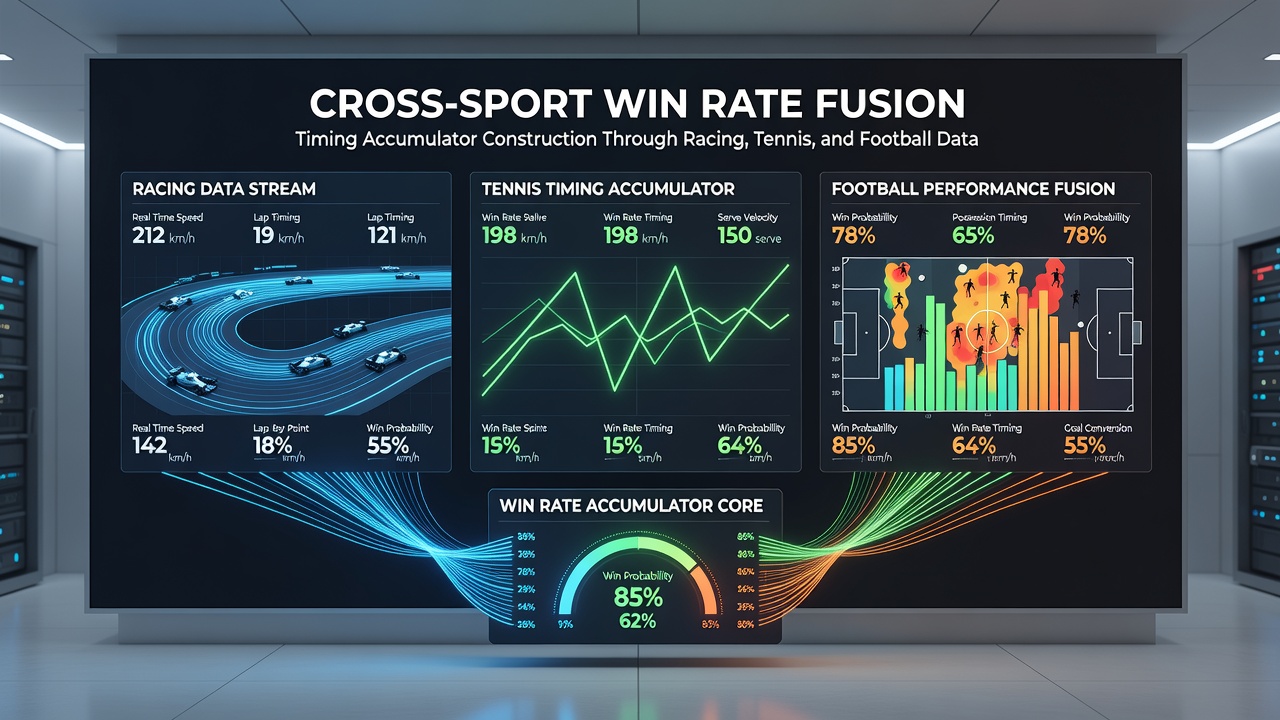
July 2026 fixtures present several natural alignment opportunities. Wimbledon’s grass-court statistics sit alongside Royal Ascot’s straight-track sectionals and the opening weeks of the new football season, creating a compressed data environment where serve dominance, sprint times, and early-season clean-sheet percentages can be cross-referenced within days of one another. Operators have begun releasing preliminary probability grids that adjust accumulator odds in real time as each sport’s opening numbers are confirmed. Those grids rely on the same fusion logic that treats every completed event as an input rather than a standalone result.
Limitations and Data Quality Considerations
Variations in rule changes, surface maintenance, and squad rotation can disrupt previously observed overlaps, so models require continuous recalibration. Weather interruptions in racing or rain-affected tennis sets introduce noise that must be filtered before the football leg is added. Regulatory filings from the Nevada Gaming Control Board emphasize the need for transparent methodology disclosure when operators market fused accumulators to the public. Accuracy therefore depends on maintaining separate verification layers for each sport’s raw feed before any cross-multiplication occurs.
Conclusion
Cross-sport win-rate fusion supplies a structured approach to accumulator timing by treating racing, tennis, and football datasets as interconnected variables rather than separate silos. The method relies on documented overlaps in performance metrics and staggered placement windows that respect each sport’s natural schedule rhythm. Continued collection of aligned event data through 2026 and beyond will determine how reliably these fused sequences maintain their statistical edge.